Peter Ezenwa Orji Foundation is a road map to Amainyi community development agenda, says Eze Ogbonna
From Everest Ezihe, Ihitte Uboma
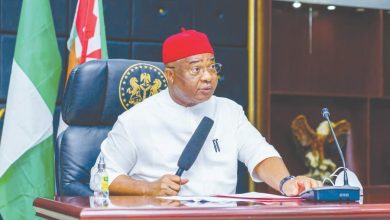
Poised by his commitments in the present and future development of Amainyi autonomous community in Ihitte Uboma Local Government Area of Imo State, HRH Eze Pharmacist Emeka Ogbonna (Inyi 2, Eze Ohazurumee) has identified Peter Ezenwa Orji(Bigdo) Foundation’s mission of patriotic leadership trainings and empowerment of prospective leaders of the community as a strategic road map for the revered community much needed accelerated developments and transformations.
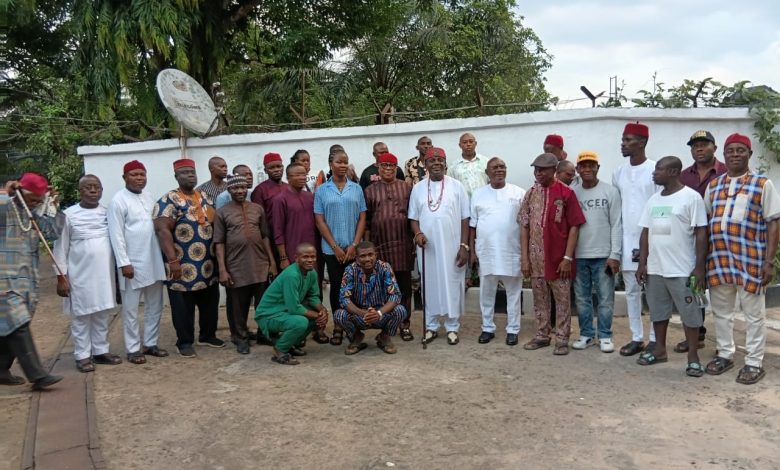
Eze Ogbonna who’s the traditional ruler of Amainyi autonomous community, as well as the Vision Bearer and Founder of the Foundation disclosed this on Sunday during the unveiling of the Foundation and her well attended leadership training at Hon. Peter Ezenwa Orji (Bigdo), Umueze Agu Amainyi ancestral compound.
The Royal Father pointed out that he choosed the Foundation name based on the contributions of the personality in the overall development and transformation of ancient community.
He pointed out that the Foundation which is non governmental organization has been registered with the Corporate Affairs Commission, CAC as a strategic means of immortalizing the community’s illustrious son for his passionate, compassionate and patriotic leadership sterling qualities which he selflessly used for the socioeconomic development and advancement of the ancient community.
The Vision Bearer and Founder applauded Hon. Peter Ezenwa Orji (Bigdo) for being a role model and an architect of brotherhood in all his endeavors and assured him that history and posterity will always remember him and his legacies to the society and humanity at large.
Earlier, the traditional ruler delivered a well articulated impactful leadership address that anchored on the strategic mission and vision of the Foundation within the 21st century, which also received an overwhelmed standing thunderous ovation by the participants.
According to him, “to the young men and women seated here today who are about to begin something none of you yet fully understand: Welcome to the founding moment of the Peter Ezenwa Orji Foundation.
“I want to begin not with an agenda, not with a curriculum overview, not with a list of what we will teach you. I want to begin with a question; one that I hope will follow you for the rest of your life.
“If the greatest crisis of our time is a crisis of leadership, and the greatest crisis of leadership is a crisis of the inner world of leaders, then what kind of institution must we build to address it at the root? That question is this Foundation.
“We stand at a moment in history when the world has more information than any generation before us, more technology, more connectivity, more awareness of what is broken and why and yet it feels, to many of us, as though the quality of civic leadership is declining rather than rising.
As though the people entrusted with the greatest responsibility are the least prepared to carry it, I have sat with that paradox for years. And what I have come to understand deeply, not theoretically is this:
“The world does not lack ambitious people. It does not lack clever people. It does not lack people who want power. What it lacks, desperately and urgently, are people who have done the interior work necessary to wield power in service of others rather than in service of themselves.
“That is what we are here to build. Not politicians. Not career civil servants. Not people who have learned to perform leadership.We are here to build architects of reality.
“People who understand that the world they wish to see must first exist inside of them, with such clarity, such conviction, such emotional and moral coherence that its emergence in the outer world becomes not a hope but an inevitability” he assured.
The Vision Bearer regretted that leadership has for centuries forgotten that, human civilisations understood something men have largely forgotten in the age of political science degrees and campaign strategy consultants.
Ogbonna juxtapositioned that leadership was first and foremost a spiritual and philosophical enterprise, insisting that great leaders of antiquity, regardless of culture, continent, or creed were formed before they were deployed.
According to him,”they were subjected to rigorous inner examination, to the development of character, to the cultivation of wisdom that goes far deeper than knowledge.
The Stoics of ancient Greece understood that the sovereign leader must first be sovereign over themselves. The great African kingdoms built leadership traditions grounded in communal responsibility, ancestral wisdom, and the understanding that a Chief who could not govern his own impulses had no right to govern a people.
“The philosophical traditions of Asia taught for millennia that inner cultivation was the prerequisite, not an optional supplement to outer governance.However,
somewhere in the rush toward modernity, we lost that thread.
“We began to select leaders by their ability to win, not their readiness to serve. We began to evaluate leadership by its visibility not its integrity. We began to confuse the performance of strength with actual strength, the appearance of confidence with actual clarity, the volume of a voice with the weight of what it is saying.
“We have built political systems that reward reactivity, punish depth, incentivise tribalism, and mistake the echo of old ideas for the voice of genuine vision”.
The revered traditional ruler pointed out that the consequence is not merely bad governance, but rather the consequence is communities that have learned to distrust their leaders as a matter of survival, and young people who look at the institutions designed to serve them and feel correctly, that those institutions were not built with them in mind.
The consequence, he said is a generation of young people of extraordinary potential, sitting on the outside of systems they have the capacity to transform, because no one has ever told them that the distance between where they are and where they could be is not a matter of connection, or funding, or access, it is a matter of formation. This Foundation is that formation.
The Vision Bearer further identified the Philosophy that guides the Foundation ,”let me tell you what we believe here. Not what we teach what we believe. Because every curriculum is downstream of a philosophy, and if you do not understand the philosophy, you will mistake the curriculum for its own purpose.
“We believe that reality is not happening to leaders. Reality is being produced by them: by the quality of their thinking, the coherence of their beliefs, the depth of their character, and the alignment between what they say and what they do.
“We believe in six universal laws that have governed human experience since before any of the institutions in this room existed.
“Laws that ancient philosophers discovered independently across civilisations that never communicated with each other. Laws that modern neuroscience is now confirming in laboratories. Laws that every great leader who ever lived has operated by; whether they named them or not.
The Laws he informed are Law of Oneness,The Law of Recurrence,The Law of Attraction, The Law of Correspondence, The Law of Non-Resistance and The Law of Timing.
“These are not ideals we aspire to. They are operating principles we train by.They are the philosophical backbone of every module, every exercise, every conversation that will happen inside this Foundation.
If you understand them, truly understand them. You will never again be a passive recipient of your political environment.You will be its architect.
The Vision Bearer said it point blank that,Peter Ezenwa Orji Foundation curriculum is not a series of workshops. It is not a certification programme, neither is it a collection of lectures delivered by experts to passive recipients, but rather it’s a complete formation system, designed to transform your relationship with yourself, your community, your State, your nation, and the systems of power that shape civic life.
“We begin inside, because there is nowhere else worth beginning. The first track of this curriculum; Character and Inner Governance is the most important thing we will ever teach you. Not because it is the most dramatic. But because it is the most foundational.
“You will be asked to examine your own mind not philosophically, but forensically. To trace the patterns in your life back to the beliefs that produced them. To identify the assumptions you have been living by without ever consciously choosing them”.
Ogbonna further disclosed that the participants will be honestly asked to sit with their own limitations, and to trace their patterns to their roots, even when those roots are painful.
“To challenge assumptions you have held so long they feel like facts. To persist in your new convictions through the period when your old reality is still playing out around you, when every external signal is telling you that nothing has changed, when the temptation to retreat to the familiar is at its most seductive.This is what we call the echo period.
“The window between the moment you plant a new seed and the moment that seed becomes visible. Every genuine transformation lives in this space. And it is in this space that most people give up, not because the process is not working, but because they do not understand that the absence of immediate results is not evidence of failure. It is simply the nature of real growth.
“Most people overestimate what they can change in a week and underestimate what they can become in a year of genuine, disciplined inner work. This programme is a year. Give it the year it deserves.
“You will also be challenged in your relationships. The leader who is genuinely becoming something new will find that not everyone around them is comfortable with the change.
Some will celebrate it. Others will resist it, not from malice, but from the perfectly natural human anxiety that arises when someone they know begins to outgrow the role they have assigned them.Hold your course. This is part of the formation.
“And you will be challenged in your civic life. You will encounter systems that resist change, institutions that protect their dysfunction, communities that have been disappointed so many times they have learned to treat hope as a form of naivety.
“You will encounter the cynicism that masquerades as sophistication, the tribalism that masquerades as loyalty, the small thinking that masquerades as pragmatism. Do not catch it. Do not become it. Do not make peace with it.
You are not here to manage what exists. You are here to build what must exist. That is a different mandate. It requires a different character. And character; real character, not performed character, is built precisely in the moments when holding your ground costs you something”.
He reassured that the Foundation is also tailored towards building a generation of young African leaders and young leaders across the world who have reclaimed the ancient wisdom that inner sovereignty is the precondition of outer governance. Who have understood that the quality of a nation’s institutions is downstream of the quality of the people who build and inhabit them. Who have refused, categorically and permanently, to make peace with the gap between what their communities deserve and what they have been given.
“I see community town unions where the debates are grounded in genuine systems analysis rather than political theatre. Where the question being asked is not ‘What can I do before the next election?’ but ‘What does this community need across the next generation, and what must I plant today that I may not live to harvest?’
“I see national legislators where the voices of the least-served communities are not merely represented; they are genuinely heard. Where policy is designed in genuine consultation with those it affects.
Where the gap between what is promised and what is delivered is treated not as the acceptable cost of political realism but as a moral failure that demands accountability.
“I see a new generation of civic institutions built by people trained in this programme and others like it that do not fit neatly into the existing categories of government, business, or civil society, because they have been designed from first principles to solve the problems that all three sectors have failed to address alone.
“I see leaders who have learned to build coalitions across lines of difference not because it is strategically convenient but because they have understood that at the level of lived conviction, not intellectual assent, that we are one system. That the suffering of any part of us is the suffering of all of us.
That the flourishing of the least-served member of a community is not a charity project — it is the measure of whether the community is actually flourishing at all.
He x-rayed his commission to the participants by informing them that they were not brought here by accident,”I do not believe in accidents. Not in this context, not with stakes this high.You are here because something in you responded to a call that most people, when they hear it, find reasons to ignore. Because comfort is easier than formation. Because the performance of leadership requires so much less of us than its actual substance. Because building the inner world that genuine leadership demands is invisible work and our world has very little patience for invisible things.But you are here. And that means something” he insisted.
“It means you have decided perhaps not fully consciously yet, but decided nonetheless that the gap between the world as it is and the world as it must be is your responsibility to close. Not alone. Not without support. But yours. Owned. Non-negotiable.
“So I commission you today not with instructions. Instructions are for employees. I commission you with a vision and I trust you to find your own path inside it.I commission you to govern your inner world first. To treat your own mind as the most important jurisdiction you will ever hold. To do the work of Track One with the same seriousness and rigour you would bring to the highest office because the highest office begins there.
“I commission you to serve your community without agenda. To show up before you need anything. To listen more than you speak. To earn trust through consistency rather than manufacture it through communication strategy.I commission you to think in systems. To be dissatisfied permanently and productively dissatisfied with any analysis of a public problem that stops at its surface.
“To ask always: what structure produced this? And what would need to change in that structure for something different to emerge?I commission you to build across difference. To sit across from people whose worldview challenges yours and find the shared humanity beneath the disagreement. To be defined by what you are building not what you are opposing.
“To resist the tribal pull with every instrument of character this programme will give you.I commission you to plant seeds for harvests, you may not live to eat. To govern with a fifty-year lens in a world that demands a five-second response. To be the kind of leader whose decisions look wiser with the passage of time not the kind whose decisions require the passage of time to be forgotten.
“And I commission you to persist. Through the echo period. Through the resistance of systems that do not want to change. Through the disappointment of setbacks that look like verdicts but are only redirections. Through the loneliness that sometimes comes with being ahead of the consensus.
“Persist. Because the world you are building is real. It exists right now as a potential waiting to manifest. Your job is to hold it clearly enough, serve it faithfully enough, and build toward it persistently enough, that it must emerge”.
Ogbonna concluded by saying, that”the world has always been changed by small groups of people who refused to accept, that the world as it is, represents the limit of what the world can be. Not by majorities. Not by institutions. Not by the consensus of the comfortable, but by small groups. By people who understood that reality is not a fixed object to be navigated but a living system to be shaped — by those with the clarity to see it and the character to shape it well.You are that group.
“Not because I have decided you are. But because you are here. Because the same force that has driven every genuine reformer, every authentic servant-leader, every builder of institutions that outlasted them that force is in this room today. I can feel it. And I suspect, if you are honest with yourselves, so can you.
“We do not need many of you to change everything. We need enough of you who have done the inner work who have become genuinely sovereign, genuinely skilled, genuinely committed to hold the field long enough for the next generation of builders to take the torch.
“That is the mandate. That is the vision. That is what this Foundation is for.And it begins today. Right here. In this room.Welcome to the Peter Ezenwa Orji Foundation.Welcome to the work”.
Earlier in his welcome address, Chief Ebuka Ohaekelem, the Secretary of the Foundation expressed gratitude for the magnitude and quality of personalities in attendance just like he equally applauded HRH Eze Pharma. Emeka Ogbonna for his commitments in education and proactive development of the community as demonstrated in his being the Founder and Vision Bearer of the NGO.
Ohaekelem informed that the essence of the gathering is to explore how they as a Foundation can develop and equip the community’s young people for meaningful participation in politics, and ultimately, for better decision-making that serves the overall interest of the people.
The Secretary further identified the Foundation goal as making frantic efforts in empowering the populace with the knowledge and skills they needed for effective political engagement; so as to build a community of informed, active, and civically conscious people.
He reiterated that the Foundation is equally poised in providing mentorship and guidance to the next generation of leaders; that would promote youth inclusion in the decision-making processes that could shape their lives; and to support young people in drafting policies that would truly benefit their communities.
Ohaekelem also opined that the Foundation is adequately engrossed in the vision of, “a Nigeria, where young people do not merely observe the political process, but lead it, shape it, and breathe new life into it.
“You may wonder about the name that our Foundation bears, Hon. Peter Ezenwa Orji is more than a name — it is a legacy. He embodies a life of dedication, integrity, and selfless service, and stands as a true veteran of public life. We carry his name with great pride, and with an even greater sense of responsibility.
“He is a politician that is worthy of emulation by the young ones. Peter Ezenwa Orji Foundation is a registered NGO with the CAC Abuja, with aims and objectives of promoting civic education by raising consciousness of citizens’ rights, duties, and responsibilities; to advocate for the protection and promotion of human rights, justice and equality for all; and to support the poor and the marginalized.
“To continue driving impactful change through “Peter Ezenwa Orji Foundation”, we are a membership-based NGO” he re-emphasized.
The Secretary enjoined the people to register with N1,000 (One Thousand Naira) only, as a paid member.
The registration fee, the Foundation considers as donation that would assist in securing the resources needed for the youth leadership and mentorship programs, and as a registered member you will also have access to all their online, intangible and physical resources, as part of the benefits registered members would enjoy.
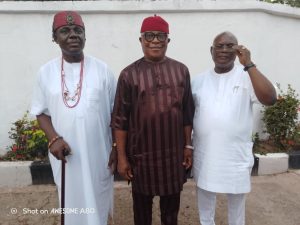
Hon.Peter Ezenwa Orji, popularly known as Bigdo who spoke extempore having held so many leadership positions both at the community, local government area, the State and Nigeria at large, including being one time Imo State Commissioner for Works, Transport and Housing, the State Treasurer of People’s Democratic Party, PDP, Board Chairman of French Village, Badagary, Lagos among others commended Eze Ogbonna for selflessly thinking out of immortalizing his name through the Foundation.
Orji advised people to shun envy, jealousness and pettiness noting Foundations as an agent of development that could be registered for various purposes.
He recalled his political antecedents with eminent personalities in Nigeria including late Dim Emeka Odumegwu Ojukwu, Owelle Rochas Okorocha, Chief Ralph Uwazuruike etc and decried the marginalization of Igbos in socioeconomic activities in Nigeria.
Orji canvassed on the need for people to embrace true patriotism as well as self reliance and to jettison low esteemed.
While advising the people, especially the youths on the need to have an open mind, sustained brotherly love through forgiven spirits and compassionate in thinking home, he also passionately enjoined them to register with the Foundation, so as to arouse and increase their consciousness in politics and leadership.
The astute politician attested that the recognition accorded to him was as a result of historical commitments in the growth and development of the community through developmental infrastructural attractions and philanthropic gestures.
He re-emphasized that the foundation will prepare them for good leadership roles in line with the 21st century’s demand and that the traditional ruler is preparing them for realistic present and future leadership roles noting that success without a successor is meaningless.
Orji said , ” all through my life, I have lived challenging wrong doings. I hate injustice and betrayal. Amainyi autonomous community is blessed with people highly educated and with impressive contacts. We’re equally blessed with modern infrastructural developments, am a born leader, that is not worried what people says about me because I know myself better than any other person or persons.
” Unfortunately, some people doesn’t like me no matter what I do for them and the society. Often times am being discredited based on envy, jealousness, pettiness, mere falsehood and hatred. However, I can never be discouraged helping my people and humanity at large.
” Despite all my efforts and contributions for the growth and advancement of Amainyi autonomous community, my greatest dream and vision is to make Amainyi great seeing her created as a local government area, certainly it will happen in our life time.
“In life you are truly recognized and respected by what you can offer and not by what you have. In those days I really suffered to make the community have 13 electoral polling units. Moreso, despite my challenges in life, I have an inner burning desire of vision and ambition of never to play second fiddle in my life endeavours. Therefore, it will be unfair if I do not transfer my experiences and contacts to the younger generation. My undying interest in life is never to be the only tree in the wilderness”.
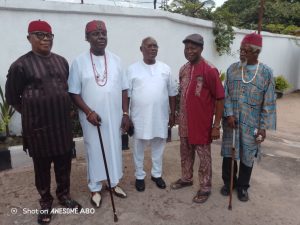
Among the eminent personalities that added their voice are Bragider General Joseph.C. Ogbonna (Rtd), the Special Adviser to Imo State government on Security Matters, Chief Iyke Chukwuocha, a senior citizen and a patriotic ambassador of the community, Chief Ignatius Obilor, the President General of the Amainyi autonomous community and Chief Jude Chukwu.
They pointed out that politics and good leadership training is every body’s business and insisted that credible leadership is the architect of community’s reawakening developments and transformations.
They also canvassed the need for unity of purpose pointing unity as the bedrocks of strength.
However, Chukwuocha, recalled that it was in a meeting like this in 1997 that a decision was taken that a son of the community should become the Local Government Area chairman, a historical feat that borne out of patriotism.
He enjoined the people to be committed and to shun backbiting and betrayal