African Youth Games Chronicles: Nigeria finish sixth as weightlifting, athletics spark hope at African Youth Games
..South Africa, Algeria and Egypt finished on the podium
By Maxwell Kumoye
Team Nigeria closed the curtains on the 4th African Youth Games in Luanda, Angola with a sixth-place finish, a result that both underlined promise and exposed the urgent need for deeper investment in youth sports.
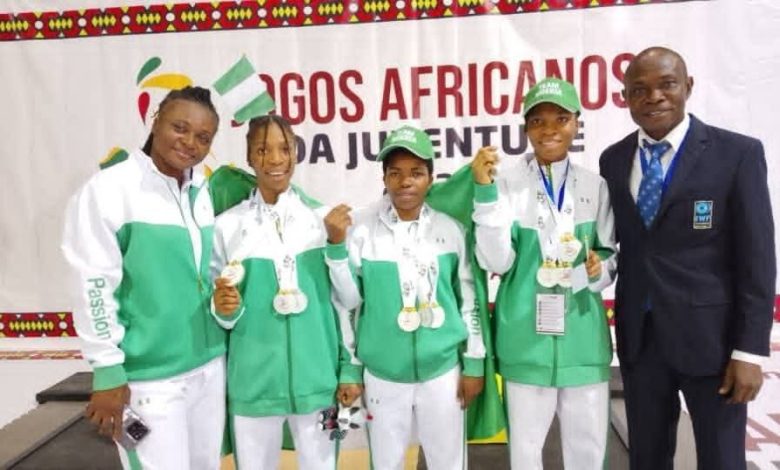
Powered largely by weightlifting and athletics, Nigeria ended the Games with 32 medals: 17 gold, 8 silver and 7 bronze.
It was a respectable haul in a fiercely competitive championship, but one that also highlighted how far the country must go to consistently challenge Africa’s emerging youth powerhouses.
Team South Africa delivered a dominant performance in Luanda, Angola, finishing top of the medal table on Saturday with the highest overall tally.
The 88-member Team South African squad, drawn from 12 sporting marking the country’s first time at the top of the standings in three editions.
Their haul surpassed the 93 medals won in 2014, when South Africa finished second in Algeria, while they placed sixth at the 2018 Games in Gaborone, Botswana
Seven of the 12 sporting codes contributed medals, with swimming, athletics, karate, weightlifting, badminton, cycling and tennis all reaching the podium during what proved to be a historic championship campaign with a staggering 99 medals, made up of 45 gold, 38 silver and 16 bronze.
Swimming led the medal charge with 61 medals, followed by athletics with 19, Karate and weightlifting each contributed six medals, cycling added three, while badminton and tennis secured two medals apiece.
Nigeria found itself looking up at rivals who arrived with better-prepared systems, broader talent pipelines and stronger institutional backing.
Algeria with 83 medals and Egypt with 76 medals completed the top three, with Tunisia and Cameroon rounding out the top five ahead of Nigeria. Ghana claimed the final spot in the top ten.
Kenya clinched 12 medals on the last day of the Games to place seventh overall with a total of 35 medals in the country’s first time to participate in the youthful fiesta held in Luanda, Angola.
Kenya participated in 17 out of 33 disciplines with a contingent of 87 athletes.
For Team Nigeria, the bright spots were clear. Weightlifting delivered crucial gold medals, while athletics once again proved to be a reliable medal factory, keeping the country firmly inside the top six.
These performances reinforced the depth of raw talent available, even with limited preparation and improved structural support.
Yet, the overall standings told a familiar story. Nations that have prioritized youth development over several years are now reaping the rewards, while Nigeria continues to rely on individual brilliance rather than a fully aligned grassroots-to-elite pathway.
The sixth-place finish is not a failure but it is a warning.
As the African Youth Games also serve as a pathway to the 2026 Youth Olympic Games in Dakar, Nigeria’s showing in Luanda sends a clear message: talent alone is no longer enough.
Without deliberate planning, modern facilities, consistent competitions and long-term athlete development, the gap will only widen.
Nigeria leaves Luanda with medals, pride and flashes of excellence but also with pressing questions.
If weightlifting and athletics can shine under pressure, imagine what a fully funded and structured youth sports programme could achieve.
The future is still there to be claimed. The work, however, must start now.