Tarique Rahman sworn in as Bangladeshi Prime Minister
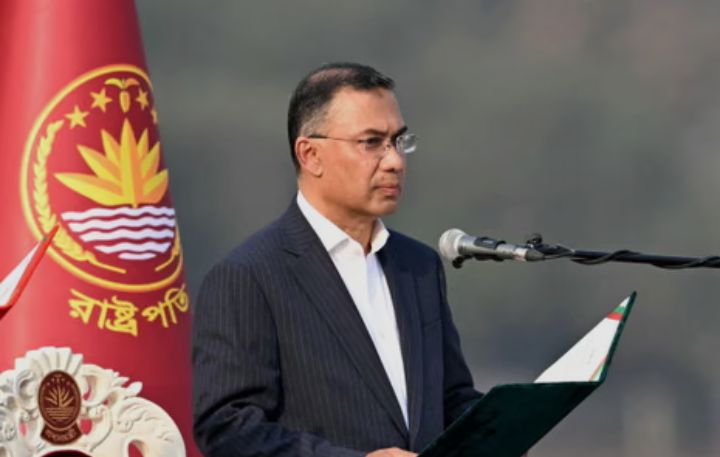
Bangladesh’s new prime minister has been sworn in, sealing a dramatic comeback for the Bangladesh Nationalist party (BNP) and formally closing the turbulent chapter that toppled Sheikh Hasina in 2024.
The swearing-in of Tarique Rahman restored an elected government after 18 months of caretaker rule led by the Nobel peace prize laureate Muhammad Yunus.
For the BNP, it marked a return from the political wilderness after being out of power for two decades. For the country, it signalled what many Bangladeshis hope will be a turning point from repression and unrest and a chance to revive the economy.
Outside Parliament, the mood was hopeful. Kamal Mia, 38, who arrived early to join the crowd, called the day “a new start”.
“I’m not saying everything will change overnight,” Mia said. “But today feels different. Now we want them to work, bring prices down, stop corruption and let people live without fear.
Rahman, 60, comes from a long political lineage. His mother was the late Prime Minister Khaleda Zia and his father, Ziaur Rahman, founded the nationalist centre-right BNP and was a central figure in Bangladesh’s 1971 independence struggle before being assassinated as President in 1981.
The BNP swept to a commanding two-thirds majority in last week’s election, securing 212 seats in the 300-member Jatiya Sangsad. An alliance including the Islamist party Jamaat-e-Islami won 77 seats.
In a departure from tradition, the swearing-in ceremony took place outside at Parliament, rather than inside the President’s official residence. Alongside Rahman, 25 cabinet ministers and 24 junior ministers were sworn in.
Rahman, who returned from self-imposed exile in London last year just before his mother’s death, said the government had “very serious challenges to face” in order to turn around the economy and clamp down on widespread corruption.
Inflation, job creation, law and order and institutional reform are expected to dominate the early weeks of his administration.
Bangladesh’s garment-dominated, export-led economy has slowed sharply under pressure from global shocks, currency strains and domestic upheaval.
“The first challenge is institutional. We have to bring the system back into order,” said Amir Khasru, a senior BNP leader who was sworn into the cabinet.
The political analyst Badiul Alam Majumdar said that demonstrating good governance would be critical. Patronage politics and corruption had become “monumental challenges”.
On foreign policy, Rahman has described China as a “development friend”, indicating Dhaka will seek to maintain strong economic ties with Beijing, even as it aims to strengthen links with western nations and reset relations with close neighbour India after a rocky period. Bangladesh is crucial to India’s security, sharing a 2,500-mile (4,000km) border.
India dispatched a high-level delegation to the ceremony, led by the lower house speaker, Om Birla, underscoring Delhi’s strategic interest in improving ties with its Eastern neighbour; and Seema Malhotra, the United Kingdom’s Minister for the Indo-Pacific, also attended.
The election also ushered in new players. The youth-led National Citizen party, formed by activists who came to the fore during the uprising, won six seats. The party’s entry into Parliament signals the gen Z demographic now has a foothold in the political system.
Voters also approved changes introducing a two-term limit for Prime Ministers and strengthening judicial independence.
As newly elected lawmakers filed into the Parliament complex for the ceremony, crowds gathered along Manik Mia Avenue, waving red and green national flags.
“Honestly, I came to just see it with my own eyes,” said Nila Begum, 33, clutching a small flag as motorcades swept past along the broad boulevard. “We’ve watched so much bad news for so long, today, people want to feel hopeful again. Let them bring some calm.”
The mass protests led by students and young activists led to the exile of Hasina, who had dominated Bangladeshi politics for more than 15 years.
She fled to India, where her continued stay has strained relations between New Delhi and Dhaka. A Bangladeshi tribunal sentenced her to death in absentia over her government’s deadly crackdown on the protests, accusing her of “crimes against humanity”.
Hasina denied the charges, saying they were politically motivated, but her secular-leaning centre-left Awami League was barred from contesting the election.
Voter turnout of 59.44% “was enough to blunt” the Awami League’s claims that the results were illegitimate, said Pearl Pandya, a senior south Asia analyst at the US-based global monitor, Armed Conflict Location & Event Data.
But, she added, accommodating the party in the new political set-up would be “a delicate task”.