Lagos state sports infrastructure crisis exposed as National Intermediate Games moves to 2027
By Maxwell Kumoye and Trust Ittai
The postponement of the inaugural National Intermediate Games from October 1–15, 2026 to the first quarter of 2027 has raised fresh questions about Lagos State’s preparedness to host major sporting events and, more fundamentally, its commitment to sporting infrastructure.
A state that prides itself as Nigeria’s economic powerhouse and home to the country’s largest economy, Lagos’ sports infrastructure story is increasingly difficult to reconcile with its public image.
The state has the resources, visibility and commercial strength to build and maintain facilities capable of hosting major national and international competitions.
Yet, year after year, some of its most important sporting venues continue to deteriorate, remain unfinished or increasingly serve purposes far removed from elite sports.
The postponement of the National Intermediate Games has now brought that contradiction into sharp focus.
According to the National Sports Commission (NSC), the decision followed a comprehensive review of preparations by the Local Organizing Committee, the NSC and an independent Quality Control and Assurance Specialist after a Joint Technical Meeting held from September 3 to 6.

The review covered proposed venues, sporting events, technical requirements, rules and regulations and other critical operational areas.
While the assessment concluded that the Games could technically go ahead, it also found that the remaining time might not be enough to deliver an inaugural edition to the standard expected of Lagos and an event of national significance.
That is a diplomatic way of saying that more work needs to be done and the uncomfortable question is, why was Lagos not ready?
A visit to some of Lagos’ major sporting facilities provides part of the answer.
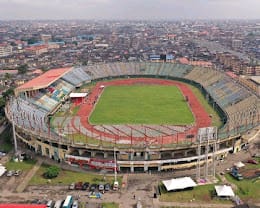
The iconic Teslim Balogun Stadium in Surulere, once a major sporting landmark and a venue associated with some of Nigeria’s biggest football moments, has increasingly assumed the appearance of an abandoned project rather than a modern sporting facility.
Instead of serving as a vibrant centre for football development, athletics, community sport and major competitions, the facility has struggled to live up to its status. Then there is the Mobolaji Johnson Arena.
What should be one of Lagos’ flagship football facilities has, in recent years, increasingly looked more like a venue for social functions and entertainment than a fully operational football stadium.
Questions surrounding the completion and consistent sporting utilisation of the facility have persisted for years.
Agege Stadium presents another uncomfortable reminder.
The facility once hosted an international football match and was regarded as an important football venue in Lagos.
Today, its condition and utilisation raise legitimate questions about how a city that wants to position itself as Nigeria’s sporting capital allows strategic sporting assets to decline.
These are not obscure facilities hidden away from public view. They are among the names that should define Lagos’ sporting landscape.
Instead, they have become symbols of a larger problem, Lagos talks extensively about sports, but the physical infrastructure required to sustain those ambitions often tells a different story.
Perhaps the most troubling aspect of the situation is the apparent imbalance between publicity and physical development.
Lagos has no shortage of media visibility. Government programmes are routinely promoted through elaborate publicity campaigns, branding, advertising and public relations efforts.
But sport cannot be built with press releases and no amount of media hype can turn a dilapidated stadium into a world-class venue.
No publicity campaign can replace a functional pitch, modern changing rooms, quality seating, athletics facilities, floodlights, media areas, medical facilities or properly maintained training grounds.
There is nothing wrong with the government communicating its achievements. In fact, effective communication is essential.
But when communication begins to overshadow delivery, it becomes counterproductive and you cannot market infrastructure that does not exist.
A state with the size of Lagos’ economic capacity, sporting infrastructure should not be treated as an occasional ceremonial project or something to be dusted off whenever a major competition is awarded. It should be a permanent investment.
The National Intermediate Games could have been an opportunity for Lagos to demonstrate what a modern sporting ecosystem should look like. It should have provided opportunity for Team Nigeria heading to Dakar the Senegalese capital for the Youth Olympics.
The competition is designed to provide a platform for young athletes and establish an operational benchmark for future editions.
Hosting its inaugural edition should therefore have been more than an event-management exercise.It should have been a statement.
Instead, the postponement has exposed gaps that should arguably have been addressed long before the Games appeared on the calendar.
The NSC has stressed that the postponement is intended to protect the quality, credibility and long-term success of the Games. That is understandable.
It is better to postpone a national competition than to stage a poorly organized event in inadequate facilities simply to meet a deadline.
But the delay should also serve as a wake-up call to Lagos.
Lagos has produced generations of footballers, athletes, basketball players, boxers and other sporting talents. Its population, corporate base and commercial influence give it enormous potential to become the country’s leading sports business and development hub.
But talent needs somewhere to train, competitions need venues, grassroots programmes need playing fields and elite athletes need modern training centres while international competitions require facilities that meet international standards.
Without those foundations, Lagos risks becoming a state that produces sporting headlines without producing the infrastructure needed to sustain sporting excellence.
The question is no longer whether Lagos can afford better sporting infrastructure. The more pertinent question is whether it has made sporting infrastructure a sufficiently serious priority.
The postponement of the National Intermediate Games provides another opportunity to answer that question.
By the first quarter of 2027, Lagos will have another chance to demonstrate that it can match its economic stature with sporting ambition. But this time, the answer should not come through publicity. It should come through completed facilities and a properly maintained pitch with functioning training centres.
And It should also come through venues that athletes, spectators, coaches and international visitors can be proud of.
Lagos does not need more hype about sports. It needs sports infrastructure worthy of Lagos.