Stop talking about Obi, explain young girl’s death controversy in your house, Obienyem to Umahi
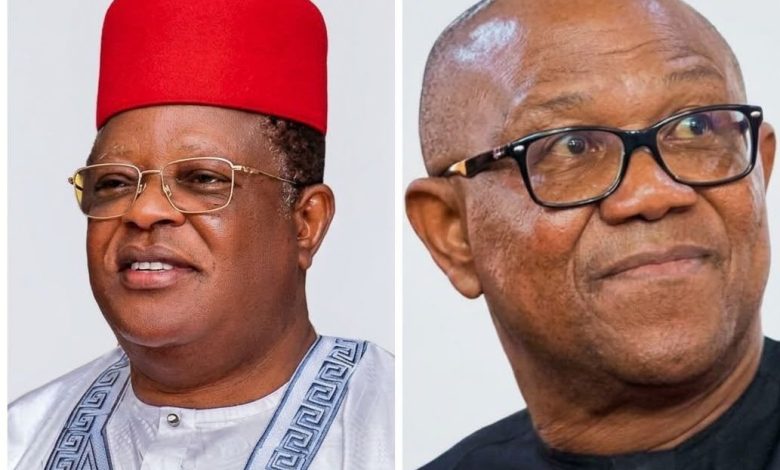
By Goodness Ndukuba, Awka
Val Obienyem, Media Adviser to former Anambra State Governor, Peter Obi, has challenged Minister of Works, Dave Umahi, to stop making Obi the subject of his political attacks and instead address controversies that have surrounded his own political career, including what Obienyem described as questions arising from the recent death of a young woman in Umahi’s house and the controversial Ebonyi airport project.
Obienyem, in a strongly worded statement on Thursday titled “Dave Umahi and Incestuous Reasoning,” was reacting to recent comments attributed to Umahi in which the former Ebonyi governor reportedly urged the people of Ebonyi State not to support Igbos from outside the state, and specifically challenged Obi to name an Ebonyi indigene he employed while serving as Anambra governor.
According to Obienyem, Umahi’s intervention represented an attempt to deploy ethnicity and place of origin as political weapons.
He argued that the movement supporting Obi, popularly known as the “Obidients”, was not fundamentally about attacking people who disagreed with Obi, but about opposition to what he described as “the systemic ills of Nigeria” and a desire for national renewal.
He accused Umahi of engaging in “politics of emotional provocation, ethnic insinuation and calculated grievance”, adding that instead of concentrating on Obi, the minister should answer questions surrounding controversies associated with his own political career.
Obienyem specifically referred to “the young lady that recently died in his house”, without providing further details or alleging responsibility for the death.
The former governor’s media aide also questioned the rationale behind the Ebonyi airport project, describing it as one of the “vanity projects” embarked upon by Umahi while a governor.
He said the airport’s “utility and economic justification became subjects of considerable public debate”, adding that Umahi’s approach to governance reflected what he called “a stunted philosophy of governance.”
Obienyem rejected Umahi’s criticism of Obi over the renaming of Abakaliki Street in Anambra, recalling that he personally criticised the decision by the then Governor Willie Obiano to rename the street.
He argued that Obi could not reasonably be expected to intervene in every action taken by a subsequent administration simply because it affected people from Ebonyi State.
Defending Obi’s record in Anambra, Obienyem said the former governor did not govern on the basis of ethnic or geographical origin.
He claimed that Obi deliberately avoided concentrating government appointments in his native Agulu and pointed out that some of Obi’s senior security officials, including the head of his DSS detail, were from Ebonyi State.
He also cited Obi’s interventions in Ebonyi during the COVID-19 pandemic and his financial support for educational institutions in the state.
The statement further recalled the 2019 presidential election, when Obi emerged as the running mate to Atiku Abubakar. Obienyem alleged that Umahi initially opposed the choice before subsequently expressing support, claiming that he personally accompanied Obi to meet Umahi in Abakaliki during the period.
He added that the experience later caused him to question Umahi’s sincerity towards Obi.
Obienyem also contrasted what he described as Obi’s inclusive style of governance with the alleged concentration of appointments among relatives and associates under some other administrations.
He questioned Umahi’s criticism of Obi on ethnic grounds, asking why a Nigerian leader should suggest that citizens should support or reject political candidates primarily because of their state of origin.
He described Umahi’s position as “the politics of fear, grievance and exclusion” and warned that Nigeria could not be rebuilt on what he called “incestuous reasoning”.
According to him, “a country of more than two hundred million people cannot afford leaders who tell citizens that the accident of birthplace should determine whom they may support, employ or regard as their brother.”
Obienyem concluded by urging Nigerian politicians to move beyond ethnic and geographical calculations and concentrate on issues capable of uniting the country.
“What the country needs is not more politics of division,” he said, but “the kind of inclusive, humane and nationally minded leadership that Peter Obi has consistently represented.”