
Uzodimma urges universities of technology to lead Nigeria’s fourth industrial revolution
...Tasks FUTO on innovation, entrepreneurship and national development during 38th convocation lecture
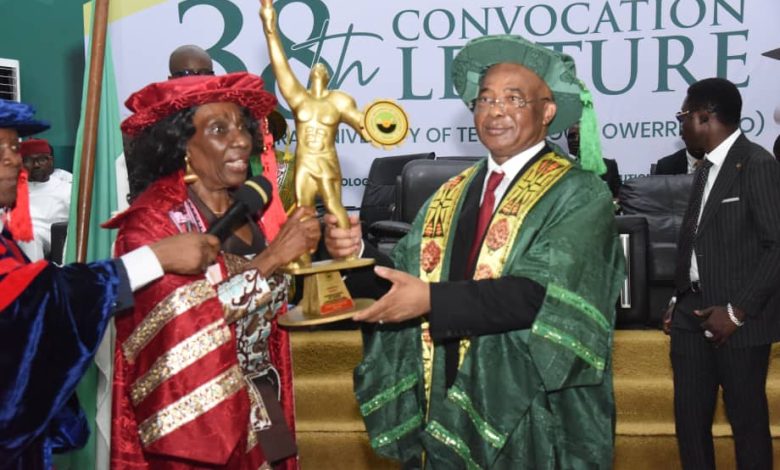
Photo: Governor Hope Uzodimma of Imo State receives a memento from the Vice Chancellor of the Federal University of Technology, Owerri, Prof. Nnenna Oti, after the Governor had delivered the 38th Convocation Lecture at the University on Thursday.
Governor Hope Uzodimma of Imo State has challenged Nigerian universities of science and technology, particularly the Federal University of Technology, Owerri (FUTO), to take the lead in preparing the country for the Fourth Industrial Revolution or risk condemning future generations to economic irrelevance.
In fact, he warned that failure to do so could undermine the nation’s future economic competitiveness and technological advancement.
Delivering the 38th Convocation Lecture at FUTO on Thursday, June 4th, 2026, Uzodimma said Nigeria and Africa missed the first three industrial revolutions and could not afford to miss the current technology-driven transformation powered by artificial intelligence, robotics, biotechnology and digital innovation.
His lecture, entitled, “Nigerian Universities of Technology Must Lead in the Fourth Industrial Revolution or Jeopardize the Nation’s Future,” formed one of the major highlights of the institution’s 38th convocation activities.
The Governor’s postulations came at a time many countries around the world are embracing emerging technologies like artificial intelligence (AI), robotics, automation, machine learning, the Internet of Things (IoT), big data analytics and advanced manufacturing systems to transform their economies, and impact national development.
Uzodimma specifically tasked FUTO on innovation, entrepreneurship and national development in line with what obtains in some climes globally.
“Our country and continent missed the first, second and third industrial revolutions. We have no excuse to miss the fourth. We either sit at the table or stare on the menu. The choice is ours.”
Uzodimma stressed that “universities, particularly institutions dedicated to science and technology, must go beyond their traditional roles as centres of teaching and research to become active drivers of innovation, industrial growth and economic transformation.”,
He emphasised the importance of sustained investment in Science, Technology, Engineering and Mathematics (STEM) education, as critical to Nigeria’s quest for industrial growth and technological self-reliance.
“The Fourth Industrial Revolution presents both opportunities and challenges for developing nations like Nigeria. While the technological wave offers unprecedented prospects for economic growth and job creation, countries that fail to prepare their workforce and institutions risk being left behind in the global knowledge economy,” he explained.
The Governor argued that Nigerian universities must position themselves at the forefront of technological development by producing graduates equipped with the skills required to thrive in a rapidly evolving digital world.
Uzodimma’s lecture harped on the need to bridge the long-standing gap between academic institutions and industry.
He emphasised that university curricula must be aligned with contemporary industry realities and emerging technological trends. He noted that such alignment would enable graduates to develop practical solutions to both local and global challenges, and enhance their employability and entrepreneurial capacity.
He urged universities to strengthen partnerships with industry players, technology companies, government agencies and research institutions to foster innovation ecosystems capable of driving sustainable development.
Uzodimma also underscored the importance of encouraging research and development activities that address Nigeria’s peculiar socio-economic needs, rather than relying solely on imported technologies.
The Governor cautioned on the consequences of inaction by the universities of technology in Nigeria, saying that countries and institutions that fail to embrace the technologies shaping the Fourth Industrial Revolution could face economic stagnation and increasing marginalisation in the global marketplace.
He then invited policymakers, university administrators, lecturers and students to collectively embrace innovation and technological advancement as strategic tools for national development.
Uzodimma said “for Nigeria the stakes are particularly high given the country’s youthful population and growing demand for employment opportunities.”
Turning to FUTO again, the Governor described the school as a strategic institution with a historic mandate to drive technological advancement, noting that the university stands at a critical juncture as it transitions to a new leadership.
To all universities of technology he urged them to reform their curricula, strengthen industry partnerships, promote research with commercial value and establish innovation hubs capable of producing globally competitive entrepreneurs and technology firms.
Citing examples from South Korea, Singapore, Estonia, Rwanda and India, where universities have become engines of economic transformation through innovation and technology-driven education, Uzodimma said FUTO and her ilk could be better equipped to do the same.
He warned that failure to adapt would worsen unemployment, brain drain and economic marginalisation, especially as emerging technologies reshape global labour markets.
The Governor also pledged Imo State Government’s support for the establishment of a technology and innovation ecosystem around FUTO, including start-up incubation, research commercialisation and industry collaboration.
“FUTO has a chance to become not just a university that teaches the Fourth Industrial Revolution, but a university that helps Nigeria lead it,” he said.
Uzodimma challenged the FUTO, and other Nigerian universities to play a more strategic role in driving innovation, entrepreneurship, technological advancement, and economic development.
He stressed that higher institutions must move beyond their traditional functions of teaching and research to become catalysts for solving societal problems and creating sustainable economic opportunities.
“The future prosperity of Nigeria will depend largely on the country’s ability to harness knowledge, technology, and innovation to address critical challenges in areas such as unemployment, industrialization, agriculture, healthcare, infrastructure, and digital transformation.
Uzodimma reiterated that universities occupy a unique position in national development because they produce the skilled manpower and research outputs needed to power economic growth and competitiveness in the global knowledge economy.
The Governor challenged institutions of higher learning, particularly FUTO to focus on generating practical solutions through research and innovation rather than limiting their activities to academic pursuits. He further argued that research findings should be translated into commercially viable products, services, and technologies capable of improving lives and stimulating economic growth.
Uzodimma called for stronger partnerships between universities, industry players, and government agencies, noting that closer collaboration would help bridge the gap between academic knowledge and real-world application.
He noted that many groundbreaking ideas generated in Nigerian universities often fail to reach the marketplace because of weak linkages between researchers and industry. He therefore advocated the development of robust innovation ecosystems that support technology transfer, start-up incubation, entrepreneurship, and commercialization of research outputs to close the gap.
To the FUTO graduating students, Uzodimma challenged them to embrace innovation and entrepreneurship as pathways to personal and national development. He advised them to develop problem-solving skills and adopt entrepreneurial mindset that would help them create jobs rather than depend solely on traditional employment modes.
Highlighting the impact of emerging technologies on global development, Uzodimma said universities must continuously update their curricula to equip students with relevant skills in areas such as artificial intelligence, digital technologies, data science, robotics, and other fields associated with the Fourth Industrial Revolution.
Uzodimma commended FUTO for her longstanding contributions to technological education and human capital development, describing the institution as “one of Nigeria’s foremost centres of excellence in science and technology.”
“The university has produced graduates who have distinguished themselves in various sectors of the economy and contributed significantly to national development,” he said.
He reaffirmed his administration’s commitment to education and youth empowerment, saying that Imo State under his watch would continue to promote policies and initiatives that encourage innovation, digital skills development, enterprise creation, and economic inclusion.
To the 2026 graduating students, Uzodimma congratulated them on their academic feats and urged them to uphold the values of excellence, integrity, hard work, and service to humanity.
However, he reminded them that graduation marked the beginning of a new phase of responsibility and opportunity, and urged them to deploy the knowledge and skills acquired at FUTO for the advancement of society.
He expressed confidence that the institution they attended would play a pivotal role in shaping Nigeria’s technological future.
In her brief remarks earlier, the out-going Vice-Chancellor of FUTO, Prof. Nnenna N. Oti, described Governor Uzodimma as the most qualified person to deliver the institution’s 38th Convocation Lecture.
She stressed that the university deliberately reserved the lecture as the highlight of the event to honour the Governor.
“I could not have chosen, the university could not have chosen, and Council could not have chosen a more qualified and distinguished convocation lecturer,” she said.
She noted that the lecture theme aligned with Uzodimma’s vision for technological advancement and development.
The event attracted dignitaries from all walks of life – the in-coming Vice Chancellor of the University, Professor Ikechukwu Dozie, members of the academia and students; captains of industry, National and State Assembly members, as well as political office holders, the clergy and religious.
The Deputy Governor, Lady Chinyere Ekomaru, the Secretary to the Government of Imo State, Chief Cosmos Iwu, the Chief of Staff Barr Nnamdi Anyaehie, and members of the State Expanded Executive Council were among those who attended the lecture.