
FIFA President’s adviser, Cordeiro quits over plan to open World Cup business to private investors
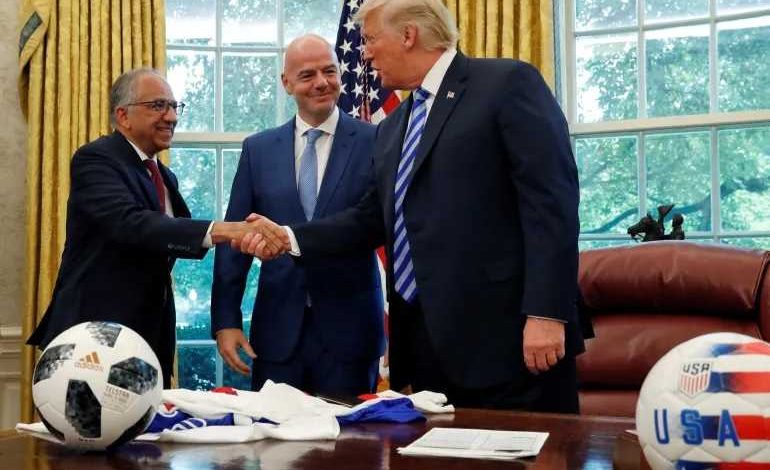
Photo: Carlos Cordeiro (left), then President of U.S. Soccer, greets U.S. President Donald Trump (right) as FIFA President Gianni Infantino (centre) looks on during a White House meeting in Washington, D.C., 2018. (Photo by Chip Somodevilla/Getty Images)
By Tayo Ogunseye, with agency reports
The crisis rocking FIFA appears to be escalating with the resignation of FIFA President’s adviser Carlos Cordeiro.
According to AIPS report Cordeiro resigned with immediate effect as Senior Advisor to FIFA President Gianni Infantino today, Friday, July 31, publicly opposing the proposal to bring private investors into a new subsidiary responsible for FIFA’s commercial and event operations.
Cordeiro, a former president of the United States Soccer Federation and an experienced investment banker, said he could not remain in his position while FIFA considered transferring a minority interest in FIFA Forward Enterprise (FFE) to external investors.
CORDEIRO BREAKS WITH FIFA “As a Senior Advisor to the FIFA President, a former banker, and a lifelong football fan, I cannot stand by while FIFA considers selling a stake in the World Cup,” Cordeiro wrote in a statement announcing his decision.
“Let me be clear: I had no involvement in this proposal and I oppose it unequivocally,” he added.
Cordeiro described the plan as “a bad deal for FIFA’s Member Associations, a bad deal for football, and a bad deal for the long-term future of the game.”
Appointed as a FIFA adviser in 2021, Cordeiro had been tasked with providing advice on global strategy, governance and initiatives to grow the game. He also represented FIFA on the White House Task Force supporting preparations for the 2026 World Cup in the United States, Canada and Mexico.
THE FIFA FORWARD ENTERPRISE PROPOSAL FIFA formally presented the FFE proposal on Tuesday, July 28. The project would consolidate FIFA’s commercial rights, including broadcasting, sponsorship, ticketing and licensing, together with the operational delivery of its tournaments, within a new subsidiary owned and controlled by FIFA.
Under the proposal, FFE would have an initial valuation of USD 20 billion and could raise up to USD 4.2 billion by offering minority, non-controlling interests to long-term investors. FIFA said it would retain sole control of the subsidiary, as well as exclusive authority over competitions, football governance, the international match calendar and sporting decisions.
If approved, each of FIFA’s 211 Member Associations would receive USD 20 million in FIFA Forward development funding for the 2027-2030 cycle, compared with the USD 8 million currently budgeted. Associations would also have the option of accessing a further USD 20 million through the proposed FIFA Fast Forward Programme.
FIFA maintained that the proposal remained at the consultation stage and could only proceed with the backing of a majority of its Member Associations and the relevant approval of the FIFA Council. Infantino described the project as an “opportunity, not an obligation”, arguing that it could unlock greater commercial value and substantially increase investment in football development.
UEFA ANNOUNCES BOYCOTT On Thursday, UEFA and its 55 national associations unanimously rejected the proposal and announced that their national teams would not participate in FIFA competitions for as long as it remained under consideration.
UEFA said the boycott would continue unless the proposal was abandoned completely and binding assurances were provided that FIFA would not open its competitions or governance to private ownership. It argued that the World Cup could not be treated as an investment product and criticised the lack of meaningful consultation before the plan was presented.
CONCACAF REJECTS THE PLANConcacaf and its 41 Member Associations also rejected the proposal following a meeting later on Thursday, expressing concern over the lack of due process, the short deadline imposed and the absence of prior review by the appropriate FIFA governance bodies.
Concacaf also questioned the need for private investment following what it called the most profitable World Cup in history. Unlike UEFA, however, it did not announce a boycott. Instead, it instructed its FIFA Council representatives to examine whether FIFA’s existing reserves could be used to increase development funding and to demand that the proper governance procedures be followed.
AFC EXPRESSES SOLIDARITY Today, the Asian Football Confederation expressed solidarity with UEFA and Concacaf, citing serious concerns about both the introduction of private investment into FIFA’s flagship competitions and the decision-making process surrounding FFE.
The AFC did not announce that its national teams would withdraw from FIFA competitions. It said, however, that the possibility of a World Cup boycott entering public discussion should concern everyone involved in the game and called for greater transparency, consultation and cooperation.
FIFA VOWS TO CONTINUE FIFA responded early today by acknowledging the concerns expressed by the confederations but said its planned consultation had been disrupted by what it described as incorrect media reports.
“We will proceed with this consultation process to ensure that each MA has the ability to express its vote based on facts,” FIFA said. It insisted that the proposal was intended to allow all Member Associations to benefit from football’s commercial potential and reiterated that FFE would not be created without majority support.
FIFA also rejected the interpretation that it intended to surrender control over its competitions, stating: “Nobody is selling football. This is not something FIFA would ever entertain.”
QUESTIONS OVER FIFA’S FINANCESDrawing on more than 35 years of experience in banking, Cordeiro questioned why FIFA needed to raise USD 4.2 billion by transferring a permanent minority interest in its commercial operations when the organisation had substantial reserves, no debt and expected revenue of around USD 15 billion during the 2023-2026 cycle.
He argued that FIFA already had the financial capacity to increase development funding from its existing resources and described the plan as “mortgaging football’s future without any compelling justification”.
Cordeiro also raised questions about the timing of the proposal, the absence of clear oversight, whether a competitive process had been followed, what governance arrangements would apply and what rights investors would ultimately receive.
He said Member Associations were being asked to make a decision of enormous consequence within barely 50 days, despite fundamental questions remaining unanswered. After concluding that he could no longer continue in his role, Cordeiro ended his statement with a clear message: “When those principles come into conflict, football must come first.”